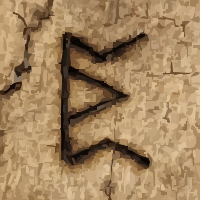
1. What is Gýgratrú?
Gýgratrú is a spirituality inspired by the giantess-worship cults of heathen Scandinavia, pre-Old Norse. It is animist-adjacent, in that it regarded the gýgjar as wardents of the earth and nature. They shaped and inhabited the land, the guided the weather. Nothing is written down about the original practices, except possibly the "Völsa þáttr," written in 1029 CE, in the Flateyjarbók. This describes a fertility ritual whose memory was preserved by the woman of a rural household. It's suspected that the story may also be Christian parody/libel of the old ways. The fact that Christians had to mock this suggests that it touched on something real and uncomfortable. The point of the story is that the woman performed a ritual to petition for a bearable winter, which the giantess (called a mǫrn) had control over.
In the modern era we don't need to make sacrifices for a bountiful harvest or a clement winter. But the giantesses are still in the hills, in the rivers, in the stormfronts. Gýgratrú is a mindset in which we trust ourselves to the larger powers of the natural world, we work with flow of nature and not contrary to it.
2. Who are the Giantesses?
Originally the giantesses were the living spirits of the natural world. Then, when Old Norse appropriated them, the jötnar were a high-level category of supernatural creatures that included þursar (monstrous and hostile), hrímþursar (frost-giants), risar (hill-giants), burgrisar (mountain-giants), troll (magical beings), skessur (strong giantesses with powerful magic), and gýgjar (terrifying witch-like giantesses).
That's according to men, anyway. Just as the gods tried to build a fortress against the natural order, men branded the giants as good or evil in the lens of their own agenda. Men named the giants, men recast them as cautionary tales in the myths, and men gave them the "opportunity" for redemption through marriage to men and baptism in the Church. All this, to tell ourselves we owned dominion over the natural order.
The giantesses are the owners and embodiment of the natural world. They are the storms, they are the waves, they are the land that men have broken into nations. Giantesses are the presence of the living world. They're not friends you ask favors of, they're not mothers who bind your wounds, they're not lovers you disappear within. In the legendary myths, they were the keepers of the protology, and no god could stand against them. That's who they are: the keepers of the oldest wisdom in existence and irresistible forces of change and growth.
3. Is this a religion?
Gýgratrú is decidedly not a religion. In its roots, it is animist-adjacent, from a period several millennia ago, when Old Germanic and Roman influence anthropomorphized natural forces and supernatural entities. Gýgratrú is not a revival of the original giantess-worship cults of heathen Scandinavia—nothing has been written down about those practices, and they were not standardized. All we know about their existence is through the works of Lotte Motz, Gunnhild Røthe, Gro Steinsland, Margaret Clunies Ross, and many others: researchers who read deeply into the Icelandic myths to find references to what came before.
Instead, Gýgratrú may be considered a heathen spiritual path being consciously re-founded. There is no mass, there is no church or congregation. This is an individual faith, not meant to attract numbers but instead to reconnect with the presence of the living world.
4. Is Gýgratrú historical or invented?
Both? It is certainly inspired by the past, as much as we can understand it (see above), but it is also my invention as I have no doctrine or documentation to base my practices on. I'm relying on my intuition and rational capacity to form the scaffolding of this faith, learn what works, revise what doesn't, and rewrite it all when new information comes along.
5. What is worship in Gýgratrú?
Gýgratrú is a place-bound, relational faith, so worship looks very different from other faiths. Rather than performing sacrifices for a bountiful harvest and a calm winter, the ritual of Gýgratrú is to foster creative output, emotional resilience, the bonds of community, bodily health, attunement with the seasons and care for the ecology. What this looks like, then, takes many forms: community service, donation to environmental projects, meditation and utiseta, and keeping to the fundamentals (enough sleep, proper nutrition and hydration, exercise, creative projects, social engagement).
After that, if you're looking for prayers and ritual, there aren't any. The emphasis is on individual communion with natural forces, embodied slowness, ecological reverence. Meditation can involve grounding with a tree, a stone, the ground itself, or a wall in your home. The point of the practice is to acknowledge something greater than yourself and surrender excess energy (rage, grief, panic, regret) or energy that isn't yours into the hands of the giantess. She's big enough to carry your burden: "Your pain is real, but it is not the largest thing present." This is containment.
6. What is the role of land and place?
There are no temples or churches in Gýgratrú. Rather than building and decorating the sacred structure for communion with the Divine, worship is done directly with the land itself. And not even one particular sacred area, like my former Giantess's Grove. Where you walk, where you sit, wherever you are, nature is there—find it. Connect with it where you are. If one area feels significant to you, if it recharges you and clears your mind of your troubles, that's great! Work with that, but don't be precious about it.
7. Is ritual required?
There is no formal ritual for Gýgratrú. If an individual gýgratrúan uses mantras or behavior to facilitate a meditative, grounding state, that's fine, but that's entirely up to the individual. If you need ritual, hug a tree, touch grass, place your palm on a boulder, or sit still and focus on each of your senses. I won't prescribe any way to do this: I have my own methods, and my answer is nobody else's.
8. Is sexuality part of the practice?
Yes, it is, but this should be private, embodied, and nonperformative, just like the practice of Gýgratrú itself. There are no tantric rituals around sexual performance or augmentation. If Gýgratrú has any guidance, it's a bracing honesty about who you are, what you like, and genuine connection with another person.
9. Is Gýgratrú solitary or communal?
Gýgratrú is a solitary, individual practice. There are no songs sung by a chorus, no hymns chanted by a following. Gýgratrú is how you engage with the world and support yourself.
10. What ethical commitments does it require?
There are no commandments in Gýgratrú. The original giantess-worship cults were discrete and localized, one group did not resemble another even when they worshipped the same giantess. For example, we don't know what the worship of Skaði would have looked like, but we know there are dozens of place-names in Sweden bearing her name—even Scandinavia itself finds its etymological roots in her name. But if we were to look at any nine of her cults, likely they would have been varied and unrecognizable to each other.
If there are any precepts, they might be these:
- You are not the largest thing present—don't make yourself the center of every narrative. The gýgratrúan rejects spiritual exceptionalism (gurus, savior fantasies, mythic grandiosity).
- Power exists, but it is not yours to wield—Gýgratrú does not sanctify domination. We oppose fascism, supremacy, coersion, and enforced hierarchy. Spiritualizing violence is anathema.
- Place is not scenery—land is something you relate to, not extract from. Care for the land requires attention and reciprocity. Harm to the land is relational damage to you.
- What is sacred is not content—Gýgratrú doesn't trend on TikTok or Instagram. It is ethically incompatible with ritual-as-spectacle and monetization. We are not ashamed, we are contained.
- Not all wounds are meant to close—we don't require healing narratives or redemption arcs. Some mourning isn't meant to end; some losses may be borne forever. Don't rush toward closure.
- Any worldview that centers land, myth, strength, ancestry, and scale must explicitly reject fascist appropriation. No "blood-and-soil," no purity narratives; we embody plurality and lived realities.
- You are small, but you are not nothing. Gýgratrú refuses both domination and disappearance. You are required to remain in relation.
11. How does one begin?
You just do. There's no baptism or initiation or hazing. You simply move into the world with an open mind and open heart, and you listen to what the living world is always speaking. You show curiosity about and care for others, rather than looking for opportunities to promote and validate yourself.
12. What is the role of doubt?
Doubt isn't the boulder under which we are crushed; it is the whetstone against which we hone our purpose. Gýgratrú cannot support "I know something others don't; I am chosen, I have access." Doubt is an ethical function to audit your beliefs and understanding. It's the difference between an unhelpful "do I believe this?" and "how do I stand in relation to this?" which supports alignment.
Doubt is not paralysis—it is containment. It isn't endless questioning or anxiety: it is a humbling uncertainty that keeps us human. Gýgratrú requires care without certainty.