Rune Poems
✦ Old English Rune Poem
Definition: a torch is burning
alive like all living things.
Fire kept close,
shining sparkling,
where we shelter within.
✦ Old Icelandic and Latin
Kaun er barna bǫl, ok bardaga fǫr, holdfúa hús.
Kaun, hulcus: puerorum molestatio, prœlii vestigia, saniei theca.
✦ Norwegian Rune Poem
Ulcer is fatal to children;
death makes a corpse pale.
✦ Icelandic Rune Poem
Kaun – Ulcer
Disease fatal to children
and painful spot
and abode of mortification.
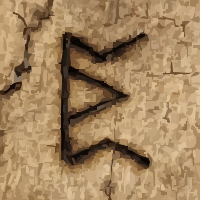
Kenaz is the sixth letter of the Elder Futhark, transliterated as the K-rune. In Proto-Germanic it was called Kauną (“ulcer, boil”), just as it is described in the Norwegian rune poem. In Anglo-Saxon, however, its name is Cēn (“pine torch”), forming the name Kenaz. There is the division: the Scandinavian tradition retains Kaunan (“ulcer”) while Anglo-Saxon prefers Cēn (“torch”). Perhaps this was a deliberate philosophical move to improve the feeling or association with the rune.
The Old English rune poem creates the imagery of a great hall, lit not overwhelmingly but just enough by torches. It is not the fire that rages out of control: it is the spark of inspiration in the darkness, the light we bring to illuminate just enough of our path to move forward. The torches may also represent an assembly of minds, each strengthening the others — wise companions gathered with intention.
The Norwegian and Icelandic traditions are far harsher, focusing on affliction and the decay of flesh. They warn of a disease that an adult might endure but which is fatal to children — the vulnerable members of a clan and its future. Kaun is treated as a scourge, a whip of torture, a natural force that consumes without regard for mercy.
What these traditions share is the dual nature of flame. Fire gives warmth, light, and life — but it also burns, scars, and destroys. Kenaz is always a small fire: a torch, not a wildfire. This limitation is intentional. It is the harnessing of a destructive element and focusing it for human use.
Too much passion can consume us just as illness can, using us up as fuel. But when contained and tended, fire becomes transformative rather than ruinous. With it we can see in the darkness, cook food, ward off cold, and illuminate the hidden corners of our own bodies and minds.
Kenaz also represents one’s inner light. How do you keep your personal fire alive? How do you feed it, share it, or protect it? Do you dim it out of fear of judgment, or burn too fiercely and exhaust yourself? Kenaz asks you to examine the shadows within — to find sickness, burn out infection, and restore vitality.
Keywords: Fire, Illumination, Passion, Ulcer, Suffering, Artistic Spark, Inner Change
Rune Reflections
- Where do I bring light into the lives of others? Where do I withhold it?
- What gifts or skills am I called to cultivate more consciously?
- Am I allowing passion to guide me — or consume me?
- In what way is suffering itself a teacher or crucible for my growth?
- Where might I be misapplying my energy?
- How can I honor the spark of inspiration when it appears?
- What do I offer Kenaz from my own inner fire?