Rune Poems
✦ Old English Rune Poem
They brook pleasure
who little understand hardship,
the sorrows & sores of living —
for those who hold
blossoms & bliss for themselves,
who find fullness in fortification.
✦ Anglo-Saxon Rune Poem (Wynn)
Wenne bruceþ, ðe can weana lyt
sares and sorge and him sylfa hæfþ
blæd and blysse and eac byrga geniht.
Bliss he enjoys who knows not suffering, sorrow nor anxiety,
and has prosperity and happiness and a good enough house.
✦ Norwegian Rune Poem
None.
✦ Icelandic Rune Poem
None.
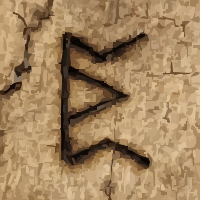
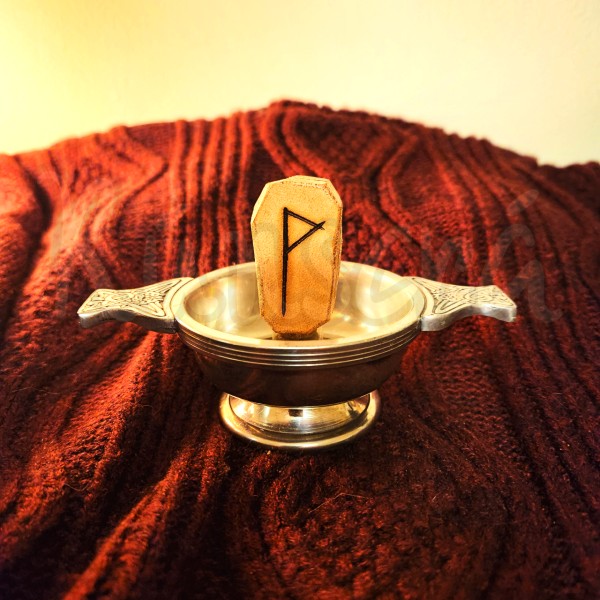
Wunjo (Proto-Germanic wunjō) is the reconstructed name of the eighth rune in the Elder Fuþark, representing joy. In Old English it appears as Wynn/Wenne which translates to "joy, bliss." It is pronounced like the W in "wind." When it was borrowed into the Latin alphabet for Old English writing, ᚹ became Ƿ (wynn). The letter Wunjo represents didn’t survive the conversion to Old Norse, so there are no Norwegian or Icelandic rune poems for this one. The W sound either merged with the V sound, or it simply disappeared from the beginnings of words. Younger Futhark used ᚢ (Úr) as a catch-all for multiple vowel and semi-vowel sounds like U, O, V, and W.
It’s generally understood that Wunjo symbolizes themes of joy, bliss, harmony, and fulfillment. It represents the satisfaction after effort, the intrinsic good feelings for a job well done or a personal achievement, as opposed to any external reward or validation. It can also extend to the shared happiness between people, the contentment that comes from a thriving and supportive community. Unlike rain or fire or giants, this rune represents a relational, emotional state, something known to all people at one time or another, even if it couldn’t be held in one’s hands. But as an abstract state, it ceased to be encoded in the Younger Futhark when the letter itself was subsumed.
That doesn’t mean that joy disappeared before the Viking Era! The concept persisted in frith: peace accords, marriage alliances, feasting, hospitality, etc. Joy is clearly apparent in the sagas with laughter in the hall, the comfort of a roaring hearth, and reconciliations between troubled parties. Rather than a force one encountered and coped with, it was something that arose among people when things fell into order, its own kind of reward after balanced effort. It was also a communal result. Joy is collective—a happy person can enliven a community, and it’s hard to celebrate your achievements all by yourself.
In the pre-Christian Norse worldview, nothing was permanent. Life was a fire that flared up and went out, just as Midgarðr would do. Joy wasn’t a treasure you could kept, it was a moment that had its own season, coming and going like summer. What made Wunjo precious, perhaps, was its transience: no one expected joy to stay for long, but you made the most of it when it was here. This was a sensation that demanded presence and intentionality, asking people to enjoy the moment for as long as it lasted. Just as hoarded wealth could rot and turn its captor into a dragon, the lesson of Fehu, trying to force joy to stay longer than was natural could only result in breaking it. What Wunjo isn’t is “toxic positivity,” which slaps “just be happy” upon any wound as an insufficient bandage.
It’s apparent to all that joy is a desirable state, all the more precious because it was temporary, but this causes different reactions in us. Some people can’t allow themselves to fully indulge in joy because it’s fleeting, they’re bracing for its loss. Others corrupt it by clinging to it too long or pursuing it relentlessly, craving more and more. It’s an uncommon soul who can simply appreciate the moment fully and not collapse into desolation when it ends. This is an important life lesson, especially when considering the lives of others, and that ties into the grim fatalism of the Scandinavian world view. Winter will always come back, and nothing good can stay.
Perhaps the verbal sigil for Wunjo would be: “This is enough, for now.”
To invoke Wunjo is to call for happiness and harmony and community, as when blessing a relationship, restoring morale, healing hurt emotions, or sealing oaths. To this end it works well with Gebo (shared joy), Ehwaz (joy moving with others), and Berkano (nurturing happiness). Appreciate Wunjo while it’s here, because the rune after it is Hagalaz: disruption, the storm. How apt, that the runes work together to highlight each other.
Keywords: Joy, Harmony, Appreciation, Satisfaction, Celebration, Contentment
Rune Reflections
- Where in my life do I experience joy as harmony with others?
- The last time I really felt deep satisfaction, what had I done to earn that?
- Where is something already "good enough" right now?
- What would resting in this moment look like, right now, even just for a minute?
- What qualities do people around me have that supports my sense of harmony?
- How do I react when joy ends: do I want more, or do I let it go?
- Is joy my guiding influence, or do I see it as a destination?