Rune Poems
✦ Old English Rune Poem
Corns of white?
Must be hail —
tumbles from lofty breezes.
Windy storms rumble it down.
In the end just water.
✦ Old Icelandic and Latin
Hagall er kaldakorn
ok knappadrífa
ok snáka sótt.
Grando hildingr.
Hail
Cold grain
and shower of sleet
and sickness of serpents.
Hagall, grando: algida seges, globorum pluvia, vermium morbus.
Hail, hailstorm:
a cold crop,
a rain of globes,
a disease of worms.
✦ Norwegian Rune Poem
Hagall er kaldastr korna;
Kristr skóp hæimenn forna.
Hail is the coldest of grain;
Christ created the world of old.
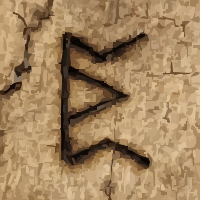
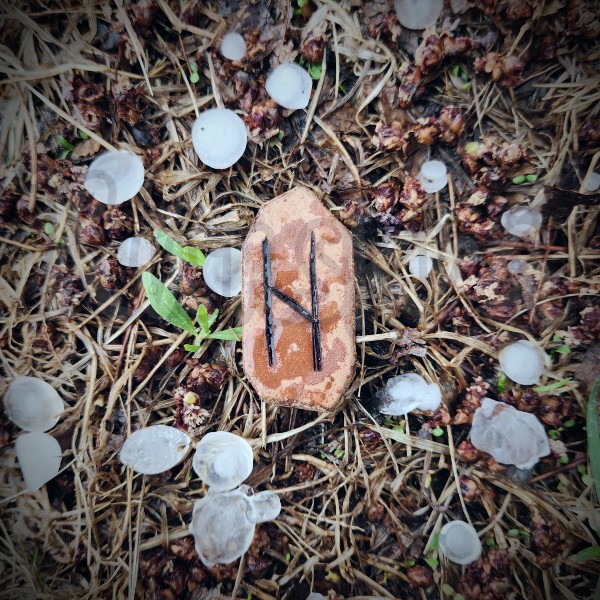
Hagalaz is the ninth Elder Futhark rune, starting the second ætt (family), the next set of eight runes. Its name follows acrophony, the sound /h/ being the first letter of its name—what I have called a mnemonic for the sound. Its reconstructed proto-Germanic form is Hagalaz, its Old Norse form is Hagall, and in Old English it is Hægl.
Second paragraph: what the rune poems say (agreements, contradictions, what that reveals).
Hagalaz's literal meaning is "hail." This rune was not symbolic, like "wealth" or "joy": it was named after a natural force in medieval Scandinavian lives, a threshold event that could ruin a year's harvest in a single storm. It's the first rune in the second ætt, sometimes called Heimdall's ætt. The rune before it is Wunjo, "joy," defined in part by its temporary nature. Joy has gone and the hailstorm comes, and after this comes need (Naudiz) and stillness (Isa). Form was established in the first ætt, and form is shattered in this family.
All the rune-poems are consistent on the theme of hail, though they have their separate takes on it. The Old English version leaves it as a natural phenomenon, no judgment—it comes from the sky, its frozen form is harmful, but it melts away, just part of the cycle. The Norwegian rune-poem is even less engaged, describing the hailstones as cold and asserting, apropos of nothing, the Christian creation myth. In Icelandic the interpretation turns a little more insidious. It observes the weather, poetically describing the ice as small as grain, noting the temperature, how it falls, but "sickness of serpents" and, clearer in Latin, "a disease of worms" reflects how disastrous this weather can be to crops. It becomes personal in this interpretation, adding its life-threatening property.
The hail doesn't come to teach us anything, that's not why it arrives. It's a force of nature that forms, swells, unleashes its impact upon the world, and goes away. In the medieval world, when it came and passed, you survived … or you didn't. Learn from that, if you like. Hagalaz represents the chaos of the natural world, a law of natural cycles that's indifferent to the works of humans. It doesn't come to teach, and it's not here to test, but in its wake it's clear what was strong enough to withstand and what wasn't. That doesn't mean that what was destroyed was inferior: Wunjo showed us that everything has its time and nothing can stay; Hagalaz hammers that point in our heads with ice pellets like grain. When it comes next time, you can try to build up even stronger, or you can learn to loosen your attachment to the physical world. Mind you, it's easier to give up on a tree you were hoping would stand but which the hail disassembled and tore down. It's much harder to be nonchalant when the food you were hoping would sustain you over the winter has been wiped out.
Existence in the Viking era balanced on a knife's edge, which explains the worldview of that people. Don't hold onto things, don't expect them to stay. Do your best, but clinging to what's gone will only harm you. Everything is temporary, everything has to go away eventually. Attaching yourself to the temporary causes needless anguish and disappontment. Perhaps they swung hard the other way, consequently, becoming unwilling to get emotionally involved with anything that wasn't immediately under their control. Even the gods knew all of the worlds, all of creation was due to be destroyed, almost all of them would be killed. They knew this in advance, but it never stopped them. Óðinn learned women's magic, þórr slaughtered female jötnar, and none of it changed anything. But you don't give up until the blow lands, until the sword strikes you down, until the hail pelts your skull and body. Even then, after the blow, you still rise again, a little bloody and battered but maybe wiser and stronger. Ready for next time, because there will always be a next time.
Hagalaz represents natural disaster overtaking us. Tremendous cost, sometimes everything, and no gain. When it destroys the crops, the family struggles to recover, and sometimes they just die. They just do. Nature meant nothing personal by it, but it was a stronger force than the system the villagers were using to stay alive. And that's just how it goes. It doesn't just destroy our systems, it forces us to question whether there's any such thing as a system, as we've structured it. If water can form into ice and fall from the sky and smash everything beneath it, then what was there to begin with? If it tears a house apart, what kind of house was it, really? What were we thinking, when we thought we could build against the chaos of weather? Was that the right decision? Was there another way? And sure, once it's done (if we've survived) we can survey the damage and make preparations for next time. We can learn from that, but the hailstorm did not form to teach us. It doesn't even show us that we are creatures who learn and adapt: We decide that on our own. All the hail did was form, destroy, and go away again. It doesn't happen to you—it happens, and you're inside it. You are in the path of a þurs, and it has nothing to do with you. It's not even aware you're there.
It's just something that happens. That's all.
Think on Hagalaz, call on Hagalaz to hammer at the stagnation in your life, break up the patterns you're relying on. Hagalaz challenges the human notion of control. It comes because wide-ranging conditions that have nothing to do with you made it inevitable. It reminds you of your own weakness, the fragility of constancy, and the indifference of the universe. Invite the natural elements to roll in and mix it up for you, if you're ready to endure (or even if you're not). This isn't going up against another fighter to test your skill—this is exposing yourself to the elements. It doesn't know you, it doesn't shape itself for you, it only comes and falls and it's up to you to withstand. Hagalaz comes in hard and impersonal, but in the end it melts away and sinks into the soil. What was it, then, that broke up your life so badly? Not good, not evil. Here and gone again.
Keywords: Hail, Disruption, Natural Catastrophe, Shock/Rupture, Trial, Fate Striking, Crisis, Reset
Rune Reflections
- What in your life believes itself permanent?
- What have you built that has never been tested?
- When disruption comes, do you resist it—or read it?
- Where are you mistaking delay for safety?
- Do you recognize the difference between destruction and correction?
- What patterns in your life repeat like weather?
- If everything unnecessary were taken from you—what would remain?