Rune Poems
✦ Old English Rune Poem
Corns of white?
Must be hail —
tumbles from lofty breezes.
Windy storms rumble it down.
In the end just water.
✦ Old Icelandic and Latin
Hagall er kaldakorn
ok knappadrífa
ok snáka sótt.
Grando hildingr.
Hail
Cold grain
and shower of sleet
and sickness of serpents.
Hagall, grando: algida seges, globorum pluvia, vermium morbus.
Hail, hailstorm:
a cold crop,
a rain of globes,
a disease of worms.
✦ Norwegian Rune Poem
Hagall er kaldastr korna;
Kristr skóp hæimenn forna.
Hail is the coldest of grain;
Christ created the world of old.
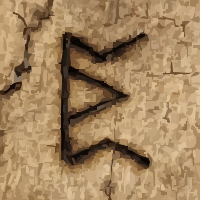
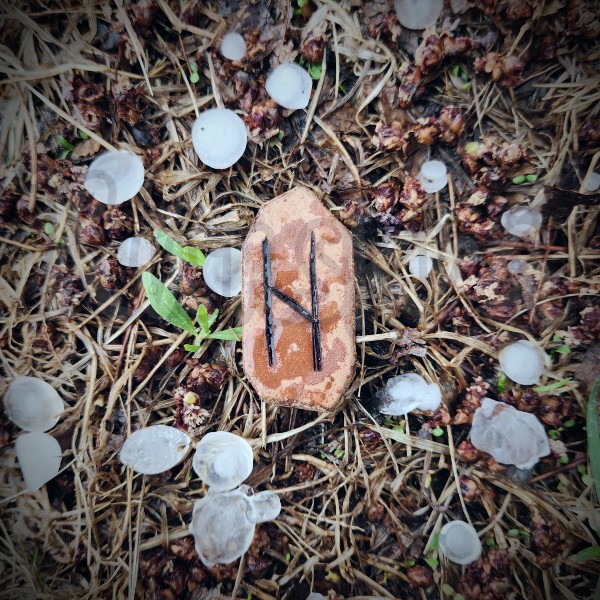
Hagalaz is the ninth Elder Futhark rune, starting the second ætt (family), the next set of eight runes. Its name follows acrophony, the sound /h/ being the first letter of its name—what I have called a mnemonic for the sound. Its reconstructed proto-Germanic form is Hagalaz, its Old Norse form is Hagall, and in Old English it is Hægl.
Hagalaz means hail. It’s a concrete representation, not abstract like “wealth,” “joy,” or “the word of the gods.” All it represents is hail, the natural phenomenon of ice pellets forming in the atmosphere and crashing to earth.
What happens next depends on who’s perceiving it. The Norwegian rune-poem for Hagalaz likens hail to grain, except colder; seeing no need for further elaboration, it emphasizes instead the power of the Christian deity. The Old English version offers a little more, describing its physical form and commenting on its cyclical nature: it forms, it falls to earth, it melts away. The Icelandic and Latin versions spell out the cost of this weather, how it can lay waste like serpents or worms, referring to the destruction of crops. Reading these poems, we transition from a neutral observation to an experienced harm and threat, from the chaos of the natural order to its impact on the world of humans.
The hailstorm isn’t a divine punishment for the misbehavior of people, it isn’t a tailored attack aimed at an individual. It isn’t a response to anything we’ve done: it is simply a natural occurrence that rises and fades. It’s not something that happens to you, you are simply caught within it. Whatever structures we’ve built for ourselves—houses, gardens, other property—the hailstorm is the cycle that shatters our patterns. This is not to teach us a lesson about anything. We can choose to learn from it, but the lesson has to be that the natural world moves entirely on its own without consideration for or awareness of us.
Its effect on us can be devastating. One powerful hailstorm can smash a home, destroy all the crops by which a family or community was hoping to survive the winter. An insensible, arbitrary blast from nature ruins all our plans and forces us to recover and make new plans. Hagalaz shows up to dispel the illusion of control and remind us of the impermanence of all things. That’s only our takeaway, because the hailstorm embodies the indifference of natural forces.
Keywords: Hail, Disruption, Natural Catastrophe, Shock/Rupture, Trial, Fate Striking, Crisis, Reset
Rune Reflections
- What in your life believes itself permanent?
- What have you built that has never been tested?
- When disruption comes, do you resist it—or read it?
- Where are you mistaking delay for safety?
- Do you recognize the difference between destruction and correction?
- What patterns in your life repeat like weather?
- If everything unnecessary were taken from you—what would remain?