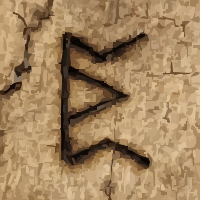

I had difficulty “feeling” Ansuz when it came time to focus. The fourth letter in the Elder Futhark, I kept forgetting about it. Its rune kinda looks like a drooping pine. All I knew about it was that it represented “sacred speech,” and right off the bat, my wife got into a shouting match about I-don’t-remember-what, but I took that to be an inauspicious start.
Oh, I remember. She was feeling down about herself, and I still had Uruz tromping around inside me and decided I’d speak up against her self-slander. She wasn’t in the mood to hear that, though, but I didn’t back down. That’s a form of sacred speech—naming things truly. I reminded her who she is, questioned the environment she found herself in, and enforced how I see her. I may have said some of this in a less-than-graceful way, which may have come off like criticism, which would be counter-productive.
Unholy Speech
That’s what I bring to Ansuz. A friend of mine once said that I “don’t just stir the pot, he kicks it over.” When I was clubbing, I wouldn’t let gossip float around. I’d confront the person who spread it, and I’d talk to the person it was about, because that was the simplest way for me to learn what was what.
That didn’t make me very popular, and gods know I loved sharing in gossip as well—I was no noble figure in the goth/industrial scene. I was described as a force of nature, and as we know in Scandinavian myth, that can be good or bad, and even when it’s bad it’s still necessary, or else inevitable.
Everyone tells themselves that they’re the truth-bringer, the one who “spills the tea.” I saw someone online explaining that phrase to their mother, who (allegedly) responded, “Well, just remember that tea stains, so be careful where you spill it.” People love to cast themselves as the sole truth-teller, the agent provocateur when everyone else is being false or holding up pretenses.
It’s also a truism that if you step back and watch them for a day, they’re at least as guilty as everyone else of the behavior they condemn. All you can do, then, is watch yourself diligently. Catch yourself when you’re about to spread a rumor; nail yourself to the wall when you’re about to swallow something that needs to be said.
Important Speech
Ansuz represents the mouth of Óðinn, the wisdom and poetry that flows from it. It represents the brackish inlet of water that feeds several rivers, where you load up your boat and adventure begins. It represents the deity—the All-Father, Jupiter (Io Pater)—all that good stuff.
Holding onto Ansuz means knowing what you’re talking about before you speak, pausing to use the most apt and powerful words available, and calling upon your higher self to speak wisely and with compassion.
This doesn’t mean your shots will land, but that’s not what this practice is about. You shouldn’t wait to speak only when you’re assured of success; you say what needs to be said, whether you need to get it out of you or someone else needs to hear it—even if they’re not ready to hear it.
It’s never wrong to tell someone you love them, to tell them what they mean to you. If they can’t handle that, that’s on them. Ansuz says that if the public square doesn’t want to hear you, you build your own temple instead—or at least write it to yourself in a journal. It has to be said, even if no one hears it.
Ansuz is the living voice that pierces the silence, the sound that so many deities uttered to compel themselves into being and start the ball rolling on creating reality.
What Ansuz taught me: don’t let fear keep you silent. You are physical motion as much as you are the swinging vibrations through the air when you speak. Life is motion and noise and heat; death is stillness and quiet and cold. Find your voice and use it, even if people hold it against you.