I’ve been looking for communities for a long time, some place to belong as I changed and grew: writers groups, goth/industrial cliques, culture and crafts groups. The progression of my creative work and personal studies has led me to Scandinavian myth, and I immersed myself in it. Necessarily, I had to find a community that would know something about this and share their education and experiences, like I hoped to.
What I’m writing now isn’t a denunciation of any group, nor a call to action against anyone. I’m only recording my experiences for posterity, so that anyone involved doesn’t believe I consent to certain actions or philosophies.
Orlæg: Why I Came to FolkRealms
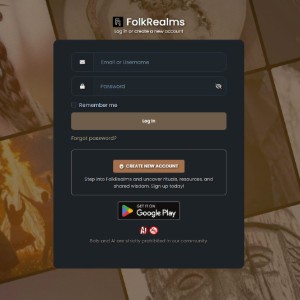
On November 26, by way of a Bandcamp email, I first saw notice of an online forum run by the Danish musican Danheim. I was a fan of his music, very atmospheric Old Norse-inspired music that could make you feel like you were in a movie. His message was simple:
Come join me on FolkRealms.com - if you seek community and connections without AI, Bots and Ads.
This struck me during a period in which I was simplifying my digital life. I’d deleted Facebook, Twitter, Instagram, and Tumblr a long time ago; more recently I’d removed all social media from my phone, because I found myself checking Mastodon and Bluesky until I felt jittery and perpetually incomplete. The idea of a community that specifically banned AI content and ads was appealing, so I went to see what FolkRealms was about.
Its users and makers portray it as a gathering ground for people who honor the “old ways,” a term very loosely defined and interpreted. Their app on Google Play described the site as a community rooted in old traditions, wisdom, and cultural heritage rather than driven by algorithmic noise and obstacles. They sounded like they wanted to encourage real conversations among real people, sharing their thoughts and experiences connected to ancestral beliefs, rituals, folklore, and historical knowledge. I thought, yes, I should find a place here.
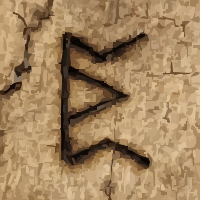
I presented myself as an informal student of Old Norse and Scandi myth. I named myself Rúnskrá, uploaded some pictures of runecarving I’d done, and pictures of me in the snow. I wrote an article about my step-by-step process and ritual for creating my own set of runes, the rationale behind every decision I made. I wasn’t bragging or showing off, but I wanted to elevate myself from lurker-status.
Hamingja: What I Found and What It Cost
In practice, the forum didn’t quite live up to these ideals. On any given day my feed might be full of dudes with their shirts off, showing off their Viking tattoos and workout regimena, or else posing with firearms. There were lots of witches too—some claimed to practice seiðr, others were unapologetically Gardnerian Wicca. The knowledge wasn’t limited to Scandinavian, either, as practitioners from Ireland to Central America posted images of their props and equipment, things I felt should have been more personal than performative.
Also? I wouldn’t have predicted it, but quite a lot of these “pagans” of “old traditions” couldn’t keep away from generative AI if their lives depended on it. Bands promoted themselves with videos clearly generated in Suno—one major giveaway is that AI cannot reliably produce accurate futhark runes. Pay attention to the details and it’s just a scribble, but these artists who dug into their history and culture to produce shamanistic pagan-folk, Viking-inspired chants and litanies saw no reason why they shouldn’t buy into GenAI. This caused some amount of discussion and conflict, culminating in stricter legislation and enforcement to keep the space free of AI artwork and content.
There were other users who were the kind of people I’d hoped to meet: people living in Scandinavian nations, people with deep and personal spirituality, who worked and created art with their hands, and who were helpful with music recommendations. Many musicians pushed their Spotify accounts for visibility, but I also encouraged #BandcampFriday for buying albums, when 100% of the purchase (minus processing fees) went directly to the artist.
It wasn’t my intention, but that kind of watchdogging became a role I stepped into. It started when I pointed out that, during the account creation process, the user’s gender (not sex) was a mandatory question. Why should that be? And if it had to be mandatory, why not include more genders than male and female?
The discussion that grew from this was never belligerent, but nor was it entire polite or considerate. One old man from the southern US (who always made a point of telling all the young women how beautiful they are) complained that I was rubbing “politics” in his face. My point was that if the community wanted to be open and inclusive to all comers, then it should work to make people feel welcome, and forcing them to conform to a gender binary would necessarily chase some people away. Others took on a begrudging reluctance to hear about it at all, insisting in a Nordic way that it was none of their business, why did anyone have to mention it. That was fine with me: strike the question, I said, and for that matter, why was marital status a required question?
The admin expressed concern that this question of gender would expand to 16 untenable options (I’d only suggested four), so he agreed that the question was unnecessary. Rather than remove it, however, they added “Other” to the options, and I was told to consider this a victory.
The second incident was with another user who shared images of himself posing shirtless with automatic rifles. He posted a prayer to the gods that included a line about preserving his “sacred bloodline.” It’s important to note that many Old Norse spiritual and cultural groups are quick to decry any affiliation with neo-Völkisch groups. “No frith with fascists” is a popular one-liner. They’re all very familiar with Norse runes and symbols being appropriated by neo-Nazis and racial supremacists, so they put in the work to assert they have no part of this and denounce it roundly.
I brought up this problematic poem to the moderators, who were on the other side of the planet from me, so my notices usually came up when everyone who ran the place had been in bed for a few hours. I don’t think the poem was taken down, but the mods told me that they’d keep an eye on that user’s account. Neither of these incidents gave me great confidence into what kind of forum I’d stumbled into.
It got better before it got worse. I wrote an article on a scholarly interpretation of the Æsir god Loki. My premise was that Loki did not fit the role of trickster-god as it manifested in any other world religion, but that when Loki did appear in a story, reality itself was turned upside-down and something important was emphasized in the characters around him. This didn’t result in any conversation but a few people liked it.
There was one problematic user who targeted me. He considered himself not just an expert on runes but The Expert, and runic discussion had to pass his approval. He gave a presentation on runes over Telegram, in order to prevent anyone from screenshotting his valuable information, despite Telegram’s security and privacy risks. In conversation with another user, he denigrated my research in heathen Scandinavian giantess-worship cults, and my own spirituality, as nothing more than a sexual fetish. This went unnoticed by the moderators, and I didn’t point it out to them.
One thing I’d tried to implement as a conversation starter was a set of daily hashtags, created by Ian Stuart Sharpe, Dr. Arngrímur Vidalín, and Josh Gillingham in their book Old Norse for Modern Times. This is a humorous but solidly researched book on Old Norse language as it might manifest in the current era, translating movie lines, social media memes, and other topics into Old Norse. They had suggested some daily hashtags: SjálfuSunnudagr (Selfie Sunday), MánudagsMæda (Monday Motivation), FylgjendaFryádagr (Follow Friday), etc. One day I’d posted ÓðinsdagsAndakt (Wednesday Wisdom), a comment upon Óðinn passing the runes from the gods to the elves and then to people.
My antagonist spoke up, pointing out that the gods were judicious in who they shared knowledge with. Indeed, in the myths, Heimdall created the Norse caste system and only shared the wisdom of the runes with the noble class. Forgetting that these were stories created by men in the context of centuries-old social structure, my antagonist insisted this was a charter that we should likewise consider the runes exclusively the domain of our elite classes—a philosophy first espoused by Aryan völkisch-mysticist Rudolph Gorsleben, whose work helped shape the ideology of National Socialism.
Wyrd: The Pattern That Became Clear
It wasn’t until he posted a YouTube video urging Norse pagans to reclaim the swastika that the moderators took any action. Another user and I reported this as soon as we saw it and commented with our objections. He doubled-down on the urgency for pagans to make the swastika acceptable again, dismissing WWII and the Holocaust as “20 or 30 years of bad events.” My argument, on the contrary, was that symbols carried as much meaning as words did, and this meaning changed over time, with usage. When a symbol became so heavily laden with tragedy and violence, there was no reclaiming it, and any attempt to do so would invite harm to anyone undertaking this. Clearly, my antagonist was testing the waters to see just what he could get away with.
My personal belief is that only one group was ever interested in destigmatizing the swastika, of course. I took note of all the users who spoke up in defense of "reclaiming" this symbol of hatred.
This time, however, I didn’t stick around to see the outcome. FolkRealms has a “block” function, which prevents you from seeing the user you block, and it prevents them from seeing any evidence of you. In effect, this only produces a kind of split-realm where one group of white supremacists and one group of earnest Scandi historians and practitioners could post and act without any awareness of each other. New users could show up, never see any fighting, never learn about the past drama, and be eligible for recruitment by either side.
This was unacceptable to me. I didn’t want anything I was writing about to draw users to the site, making newbies vulnerable to a group of white supremacists who’d received, at most, a slap on the wrist. I’m told the post with the YouTube link had been taken down, and the antagonist had his status reduced to that of a newcomer. But he was still there, and his supporters were still there. The admin had stated a policy of “absolute free speech,” asserting that we should know how to disagree like mature adults, to leave people to their opinions. I’ve seen enough “absolute free speech” platforms (Minds, Gab, Parler, Truth, the revision of Twitter to X) to know what this entailed in practice. If extremists were permitted to exist on FolkRealms, then I had to leave.
Skuld: What I Owed, and What I Do Not
I didn’t want to be a moral watchdog, but Hávamál 127 states:
“When you are aware of evil, speak out against it, and give your enemies no peace.”
I’d spoken up against gender discrimination, racial purity, elitism, and making the swastika acceptable, and not to accolades but in heated arguments. I didn’t want this to become my job, and I definitely would have liked more people to get involved in the good fight, which I didn’t see. I have to express appreciation for my friend, Thomas, who never shied from a battle and stood up for me behind my back.
My goal wasn’t to “win” arguments and “defeat” other people. I didn’t want to be the burr under the saddle with constant complaints and grievances. It shouldn’t have been up to me to “fix” FolkRealms when these issues came up. The way I conducted myself was to state the problem to the moderators—once—and walk away from the matter afterward.
At some point I was up late one night and Danheim himself—the musician, the admin—asked if anyone could help with some QA testing. I had experience with this and stayed up a couple hours, testing a strange error in posting among private groups, until it was resolved. For this reason and maybe a couple others he knew who I was, and it may have meant something to him when I said I needed to be deleted. (There was another site error that prevented me from canceling my own account, ironically.) He asked me to reconsider, and I did, but I came to the conclusion that the extremists were going to remain on the site, their fascist rhetoric normalized under the aegis of neutrality, and I didn’t want my presence to encourage anyone to encounter them. I admired Danheim’s music, I honored his diligence in maintenance of the online forum, but there was no way I could participate in good conscience.
What This Departure Means
I’m not boasting of my own moral purity. I detest performative virtue-signaling. I’m recording the events as I saw them, to underscore my heartbreak at leaving a community where I really wanted to find a seat by the hearth. I had no interest in telling other people how to live or what to think, though of course I’d prefer they didn’t embrace authoritarianism.
What is “frith”? You heard me say it in the phrase “no frith with fascists.” It’s commonly used to mean family or peace, but let me go into some depth. Old Norse friðr, Old English friþ, the most accurate modern translation is “right relationship.” It means a state of maintained peace created by mutual obligation, where “peace” is an active condition that you create, maintain, and defend through correct behavior.
Frith is the web of trust, mutual restraint, obligation, protection, and honor. When it exists between people and groups, you can move among them without fear. It’s something you offer and can expect—it is a structured safety. You create it by keeping your promises, showing hospitality, respecting boundaries, refraining from violence, and other solidly social acts. It’s not universal: it only exists within defined circles, like family, your clan, or your community.
You know Popper’s Paradox, the “paradox of tolerance”? If a society tolerates people who espouse intolerance, it risks enabling intolerance and undermining its own principles. This is the concept of the “Nazi bar,” and it’s what “absolute free speech” forums are prone to becoming.
The resolution to this paradox is frith: tolerance becomes a social agreement, and those who don’t agree to it are excluded. By its very nature, fascism cannot keep frith—it requires mutual restraint, shared obligation, respect for boundaries, and protection of the vulnerable. This is the ancient logic that modern pagans and heathens should aspire to, rather than cosplay and toxic masculinity.
As for myself, I did not find a place at this hearth, because I learned that not every hall is meant to be occupied. The old ways endure not through stubborn symbols and posturing, but through right relationship and restraint. Maybe someday I will resume the search for that relationship, but right now I find myself moving through Hagalaz and Nauthiz into Ísa—through the punishing hail that tests endurance, through the survival by discipline, and into a season of stillness and contemplation.