I don’t aspire to be a magic-practitioner. I’m not in this to learn spells, to beguile my foes and attract large sums of money to my accounts. I got into Old Norse studies because I wanted to learn what could be learned about giantess-worship cults, which necessarily existed during the oral tradition of record-keeping. Nothing was written down except memories and rumors added as incidentals by Snorri Sturluson and a smattering of Christian scholars with their own agenda. Researchers like Lotte Motz and Gro Steinsland dedicated their careers to interpreting the Eddas and Icelandic texts, cross-referencing with place-names and archaeological finds, to attempt to make out the shadows of what came before.
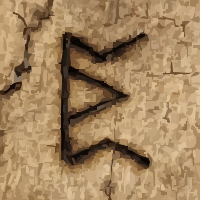
They had direction, they had vision. I wanted to learn what giantesses really were in Scandinavian myth, and I’ve done that. Now I don’t know where to go. I’m not a Viking, I don’t want to post pictures of my workout, my tattoos, or my assault rifles. I’m not a seiðrmann, I don’t launch into the astral plane to do battle with hostile shamans. I’m just a student, not a very good one, and I don’t have a destination in mind. I’m just learning what there is to know, pursuing anything that interests me for as long as it does, then receding into stillness until Kenaz’s light shows me my next step.
Lately I’ve dwelt in the void, having moved out of some communities and giving up some activities. With nothing to fill that time, I got caught up on movies and tried to resume reading and exercise. My vǫlva insists, however, that I am by nature a creative creature, and if I don’t find some way to express or expend my creative energy, the edge of that blade will eventually turn on myself. And that’s what happened: I sank into a deep depression, and I was unable to regard my past without regret and resentment. I refused to find a way forward, enacting a very small-scale tragedy in which my talents and abilities would wither, wasted, hoping the universe would notice that cost.
That’s not how that works, obviously. The gods don’t come rushing in to console the wounded hero when things get difficult. Giantesses don’t coddle their worshippers. These figures simply observe from their distant realms, waiting to see what we’ll do in the face of adversity, whether we crumple or stand up with unrelenting stupidity and pretend things could be different this time. They don’t reward you when you get up again, either. They don’t applaud, they don’t give you a powerful weapon. They don’t even let you know they’ve been paying attention, but they do. Your soul, your existence bears a weight upon the weave of the Wyrd, like the gravity formed by the mass of a large celestial body in the fabric of existence—at least according to the outmoded school of thought. You lie upon the strands of fate, woven by the Norns, and you affect the direction of the threads whether you take action or lie like a useless lump for an inappropriate length of time.
I turn to the videos by Freyia Norling as she shares wisdom flavored by deep education and experience in Old Norse ways. I don’t make recommendations in media, and I wouldn’t say she’s right for everyone, but what she says hits me the right way, uncannily at the right time. Perhaps that means my problems are so generic and widespread that her messages cast a horoscopically wide net and a bunch of us feel she’s healing us directly, as evinced in her comments. I can’t think about that, I can only give my energy to what her messages do for me. And one of the most paradoxically comforting things she’s said was a simple little phrase: “You’re not meant to be comfortable.”
That’s all. This life isn’t meant to pander to and protect you. You’re not supposed to have everything provided to forge the smoothest path possible. Conflict is what makes us interesting and strong; demanding that the world to bend to accommodate our whims and “needs” is a coma of the soul. We grow when we learn what we can cope with, when we see what we’ve survived. So when I’m having an absolutely shitty day, I hate myself and crave oblivion, and everything’s going wrong that can go wrong, I just remind myself: “How else was it supposed to be? Who could’ve made such a promise to me?” And I feel the gýgjar’s distant eyes upon me, checking me out to see what I’ll do, and I get up and throw myself back into the fray, happy to do so.
I don’t know why that phrase works for me. It sounds like it should be defeating, but it’s not. It actually lightens my spirit.
That means I couldn’t stay in this state of torpor forever, not even for a month. The gýgr, unwilling to push me down my path or suggest any course of action, only had one piece of advice for me: “write down one true thing.” I think she was talking about journaling, but I took this a few steps further. I was inspired to do so: the light of Kenaz was showing me my next steps.
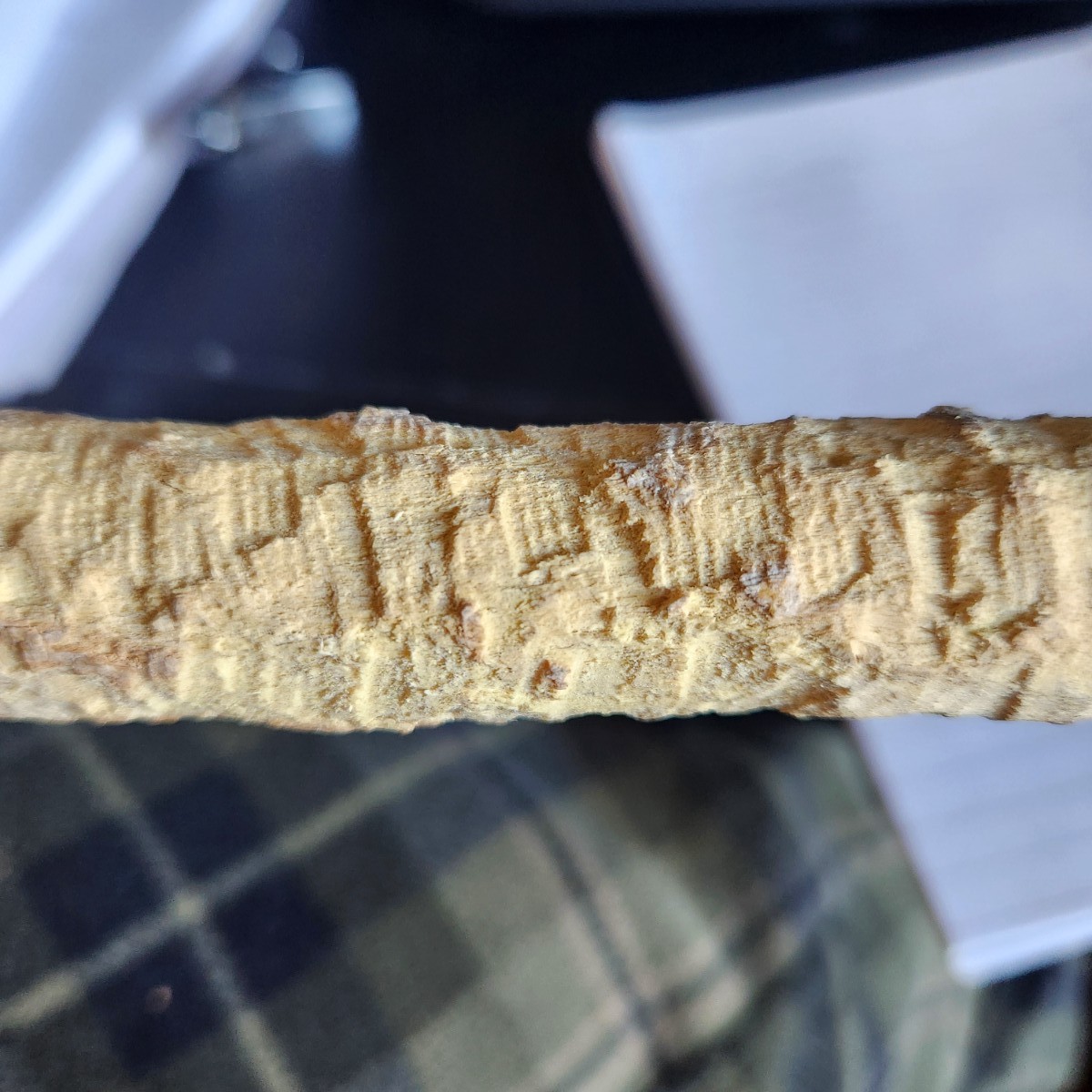
I found a branch by the Giantess’s Glade, slender and pale. The wood on one end where it had been sawn was grayed, and the length of it was stripped of bark with hundreds of little teeth-marks in all directions. It just looked cool to me, it attracted my attention for some reason, so I brought it home. It dried out there over a few weeks, because I didn’t know what to do with it until the gýgr’s suggestion. I wrote out my one true thing: I’m tired of feeling lonely. I didn’t say where it came from, I didn’t explore how it’s come to this point, I absolutely did not project how to remedy this. I only spoke my pain, plainly. Without skill or great insight, I translated it into Old Norse, then transliterated those sounds into Elder Futhark runes. I will always point out that Elder Futhark was not used while Old Norse was spoken, so this is anachronistic, but who gives a fuck? Who really cares? Who am I seriously hurting by taking this liberty? No one teaches proto-Norse, the language used when Elder Futhark was being carved. My giantess-cult studies are considerably pre-Old Norse, so I allow myself to embody on this fuþark.
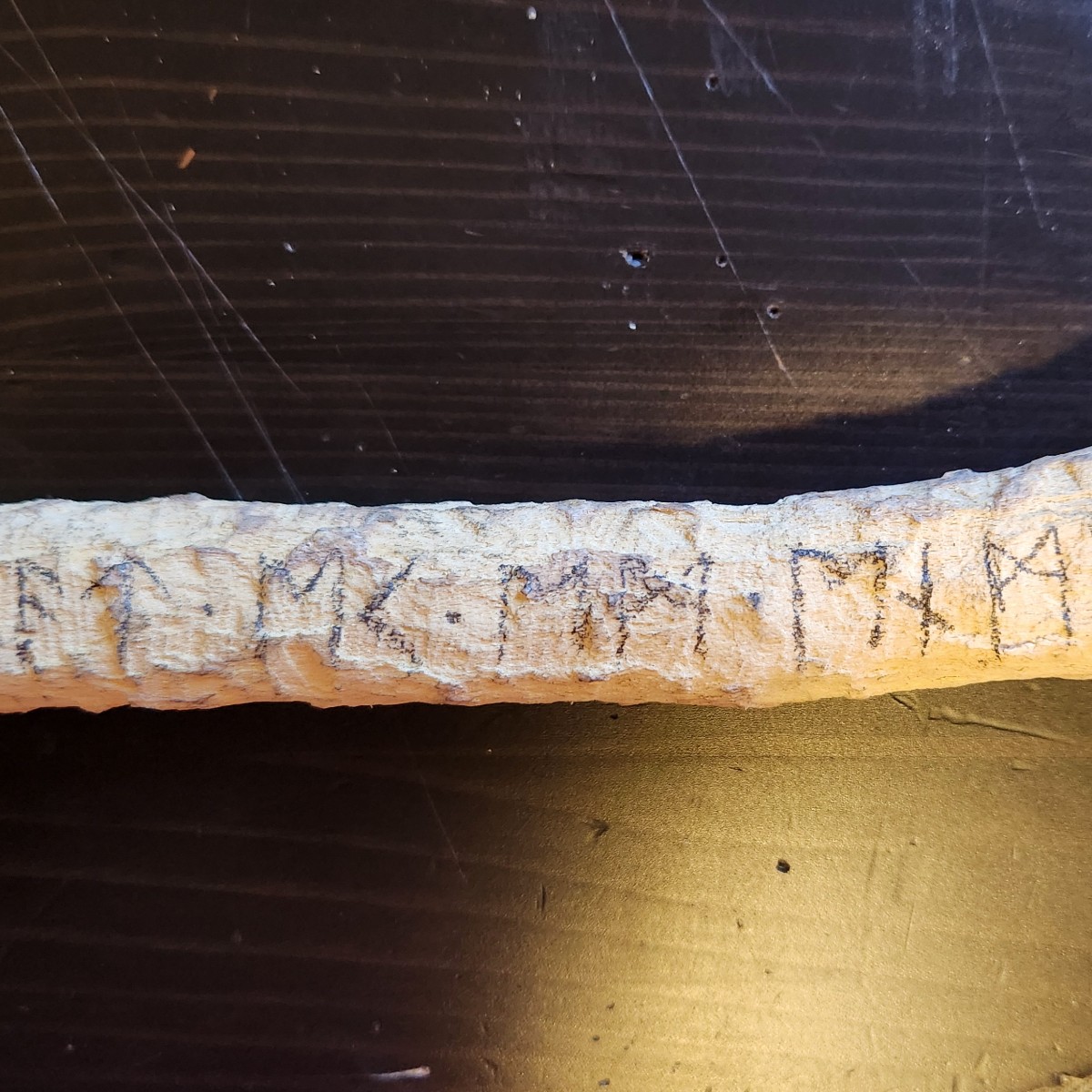
Carefully I traced the translation onto the branch, to guide my blade as I taught myself how to hack and saw into wood. No YouTube videos, just reasonable caution as I applied pressure and guided the cutting edge to make these little marks. The marks were too fine, in fact, as this dried-out wood of indeterminate nature tended to fragment and shatter under detailed work. That’s something I’ll correct next time: better wood, larger runes. A better cutting instrument would be in order, too, and maybe this would be a good time to break into woodcarving equipment. But as it happens, I'm also researching an authentic outfit and equipment for a concept I'm holding in my head, that of a traveling medieval Scandinavian scholar. What would he wear? What fabrics were appropriate? Did they have backpacks? One of the details of this costume involves a small knife, a seax but smaller, which is just a general-purpose blade for eating, carving, chopping things, and occasionally self-defense. So I could go with a professional kit or something more era-appropriate (without wanting to break the bank). We'll see.
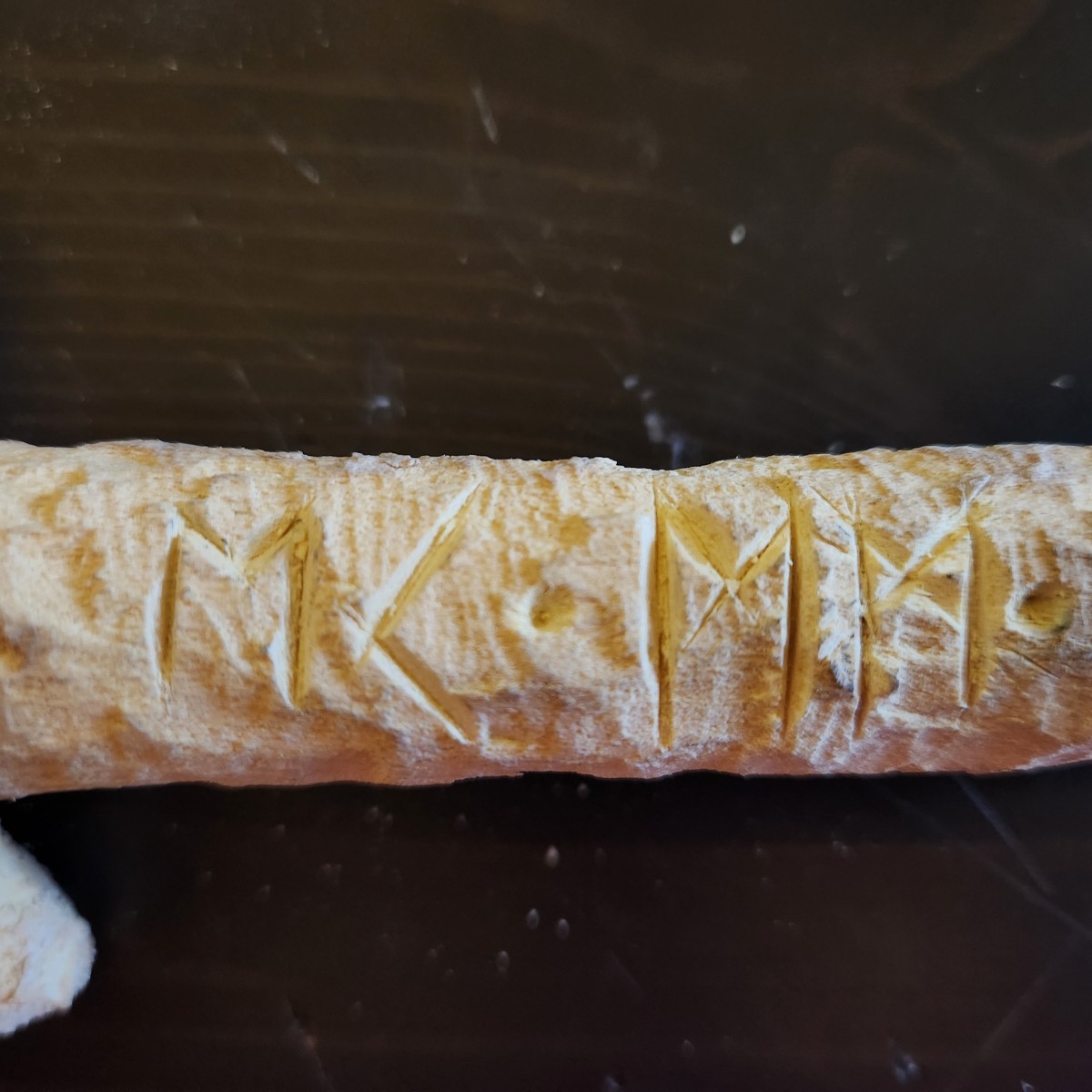
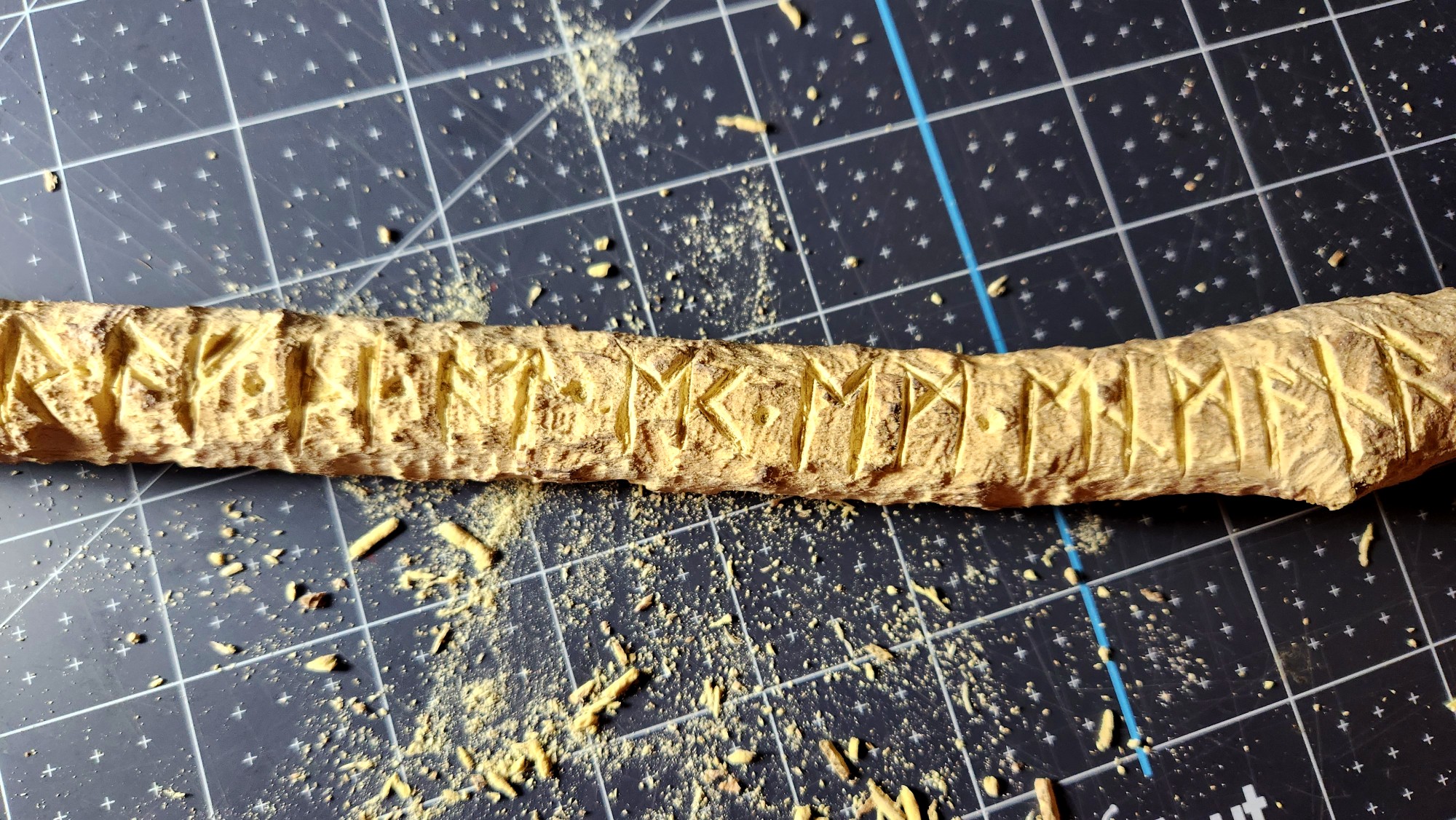
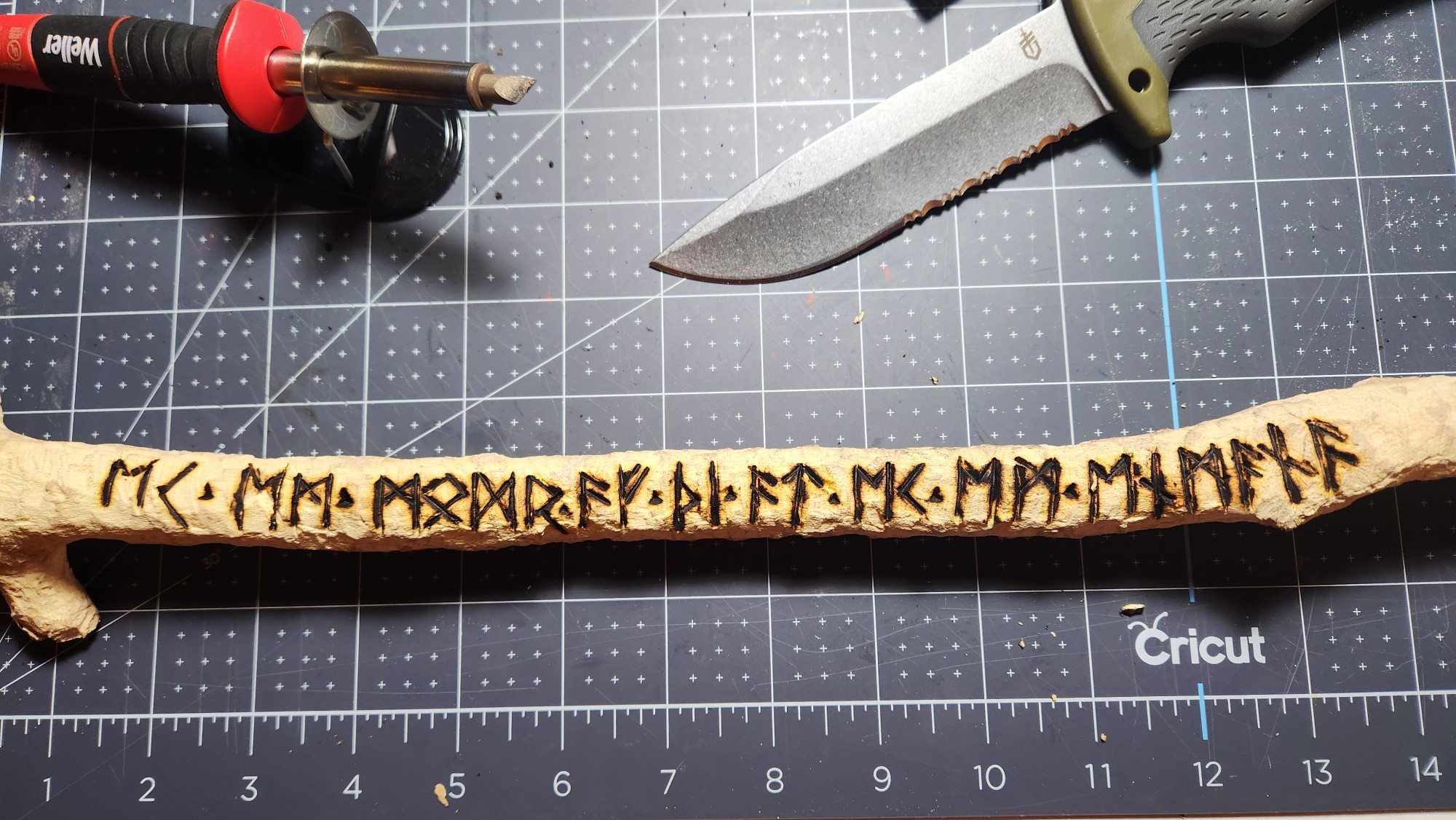
It didn’t take very long to carve these runes into the branch, really. It was an engaging evening project, carving and listening to inspiring music, and then I plugged in my pyrograph. Rather than painting in the narrow channels, I thought I’d just burn along the cuts to make them stand out. What I hadn’t anticipated—because, again, I’m inexperienced—was that the pen would get hotter along the way, so the second half of the sentence was fatter with scorch marks. It wasn’t an elegant job to begin with, but the way the burn extended over the woody fiber was a little disheartening. It took me way too long to realize that I could simply sand it down and mitigate the damage. After several minutes of 150-, 220-, and 400-grit paper, the completed runic line really looked nice. I was pleased with this, took several photos, and showed my wife, who likewise was impressed.
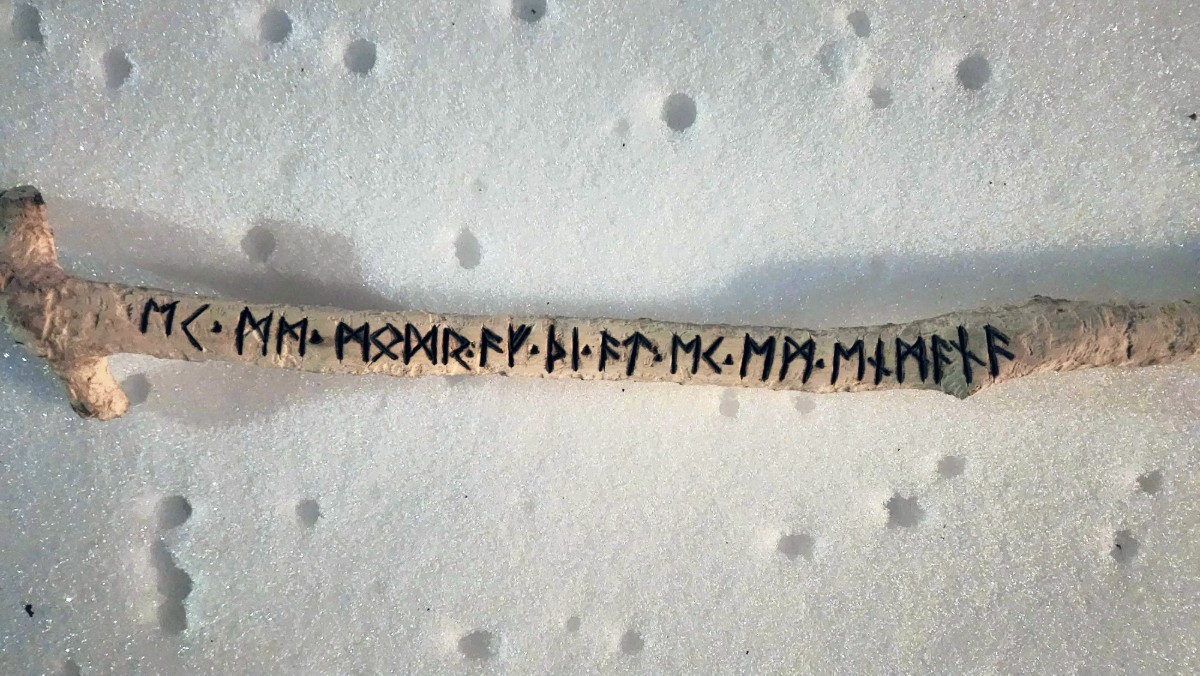
But this wasn’t a project for me to keep. It wasn’t a work of art to leave on the table for guests or mount on the wall. I had carved one line of my deep pain into this branch, and the next step was to let it go.
One additional source of discouragement for me recently was how the weather had warmed up. In my city we had a couple weeks around 50°F/10°C, so the beautiful snow was melting, turning into an ugly slush, running into the gutters. I was sad to have missed winter, choosing to focus on work instead of taking a reasonable break to get out and enjoy the ice and cold. I don’t know, for some reason, this year I was really excited about experiencing winter as much as I could. Probably the influence of my Scandinavian studies, Norse accounts I was following online, stuff like that. In some very small, safe way, I was experiencing what my far-distant ancestors knew for a fact of life. Walking out on to the frozen lake, opening my jacket, lying down on the ice and going still was my way of letting their old fingers reach into me. It was a tactile form of connection, at least in my mind, and that’s what charged this winter with so much additional energy. It seemed I’d squandered this opportunity, however, when the ugly matted lawns began to show through clumps of snow … but then a miracle happened. My city was bombarded with a snowstorm that wasn’t forecast! A thick quilt of fluffy white snow covered everything very rapidly, and the temperature promises to drop closer to zero. The first night of it, my boots crunched over perfect snowball-snow, and I ran out to the lake to lie on the ice and thank the gýgjar for their blessing. Without meaning to be self-important, it did feel as though Skaði had taken notice and given me a gift.
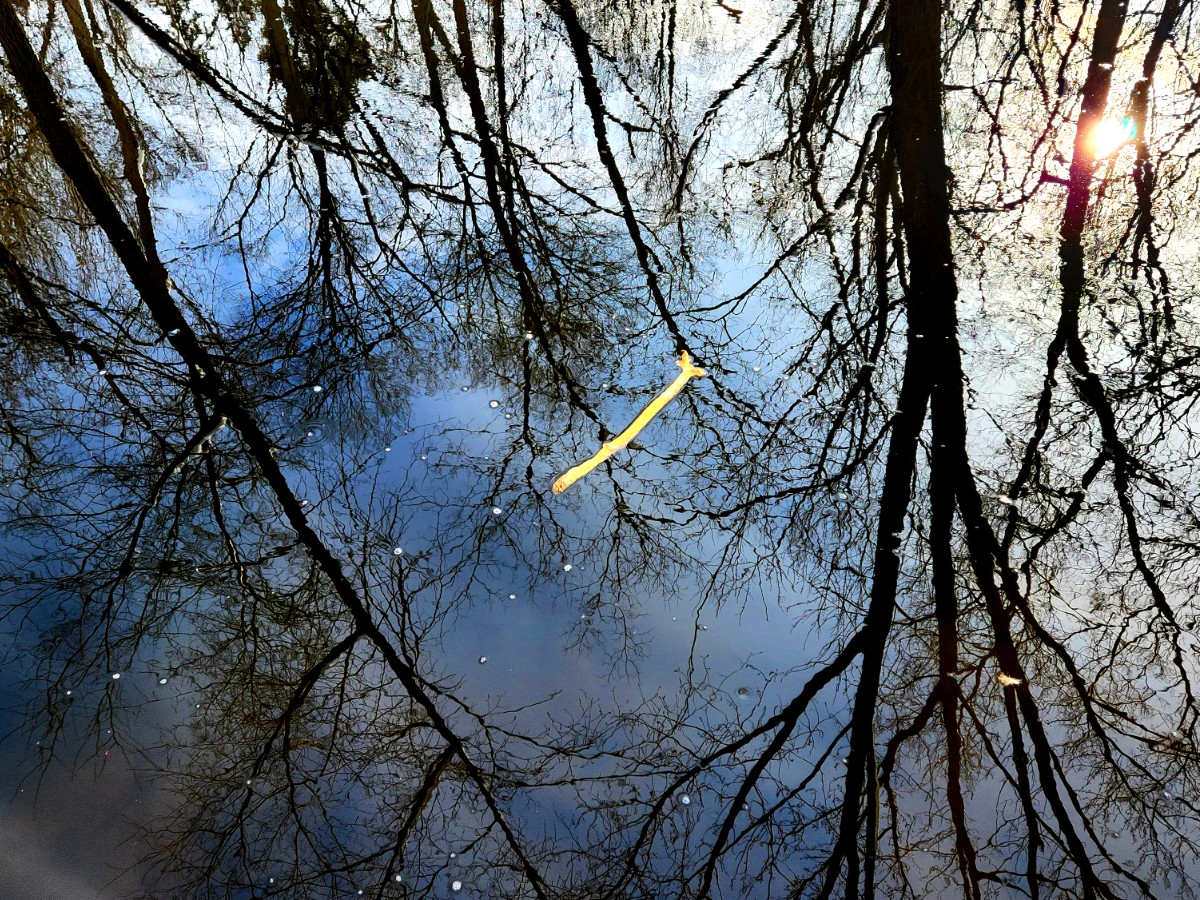
Today my wife and I walked through the cold and snow down to the Giantess’s Glade. She enjoys this natural spot, where one can momentarily forget how close they are to a city. The rounded little boulders on the banks wore cute caps of snow, the rocks in the stream had intriguing ice formations around them, and it looked like a hundred ducks had convened for parliament in the water. It really is a lovely, meaningful area. I walked a little further to the footbridge over the stream, and with a brief petition to any gýgjar happening to listen, I dropped my branch into the water. I carved and burned my dark, heavy emotions into this little staff, and I hope they floated away with it.
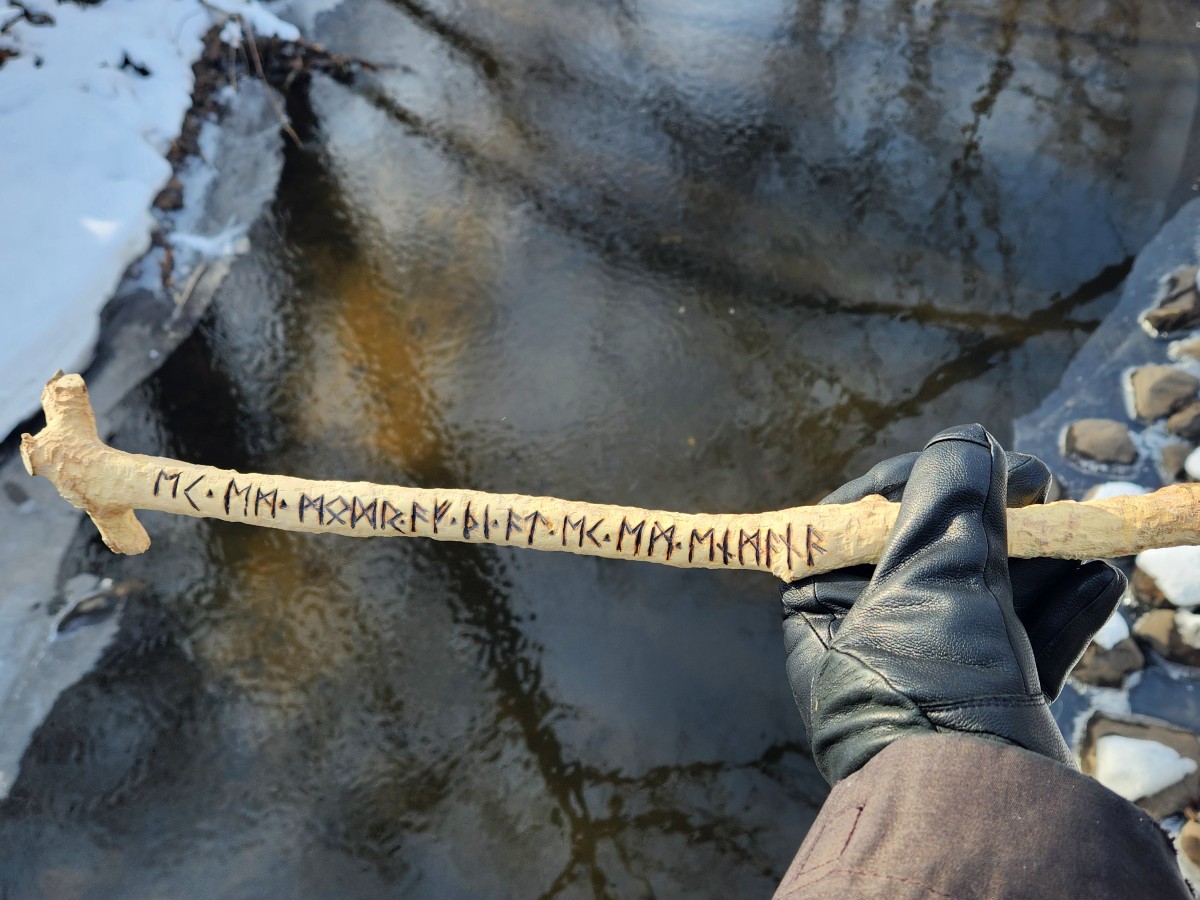
And I’m curious as to whether it’ll ever be found again, and what the finder will think.